On July 16, 1947, the Swedish Ambassador to Moscow Rolf Sohlman met with the Soviet diplomat Mikhail S. Vetrov, at the time acting head of the 5th (Scandinavian) department of the Soviet Ministry for Foreign Affairs. The topic: Follow up to earlier discussions concerning the disappearance of Swedish diplomat Roaul G. Wallenberg in the Soviet Union. Sohlman was seeking an update to the inquiries made a year earlier by his predecessor, Envoy Staffan Söderblom, during a meeting with the Soviet leader Josef Stalin. Stalin had promised to inform the Swedish government about any information he could obtain about Wallenberg’s disappearance after he had been placed under the protection of Soviet military counterintelligence forces in Budapest in January 1945.
Of the subsequent meeting with Sohlman in the summer of 1947 Vetrov wrote:
“S.[ohlman] explained that, according to the information that Stockholm has, Wallenberg wanted to leave Budapest for Debrecen, where the just formed Hungarian government was located. One cannot exclude, of course, that in Budapest or somewhere on the way something happened because at that time, there were fights and bombardments. I answered that I do not have anything new on this matter (author’s emphasis).”
Acting head of the 5th European Department, M. Vetrov [signature].”
Copies of Vetrov’s report were shared with the top Soviet leadership, including Minister of Foreign Affairs Vyacheslav Molotov, Deputy Minister of Foreign Affairs, Andrei Vyshinsky, Deputy Foreign Minister Yakov Malik and the Soviet Mission in Stockholm.
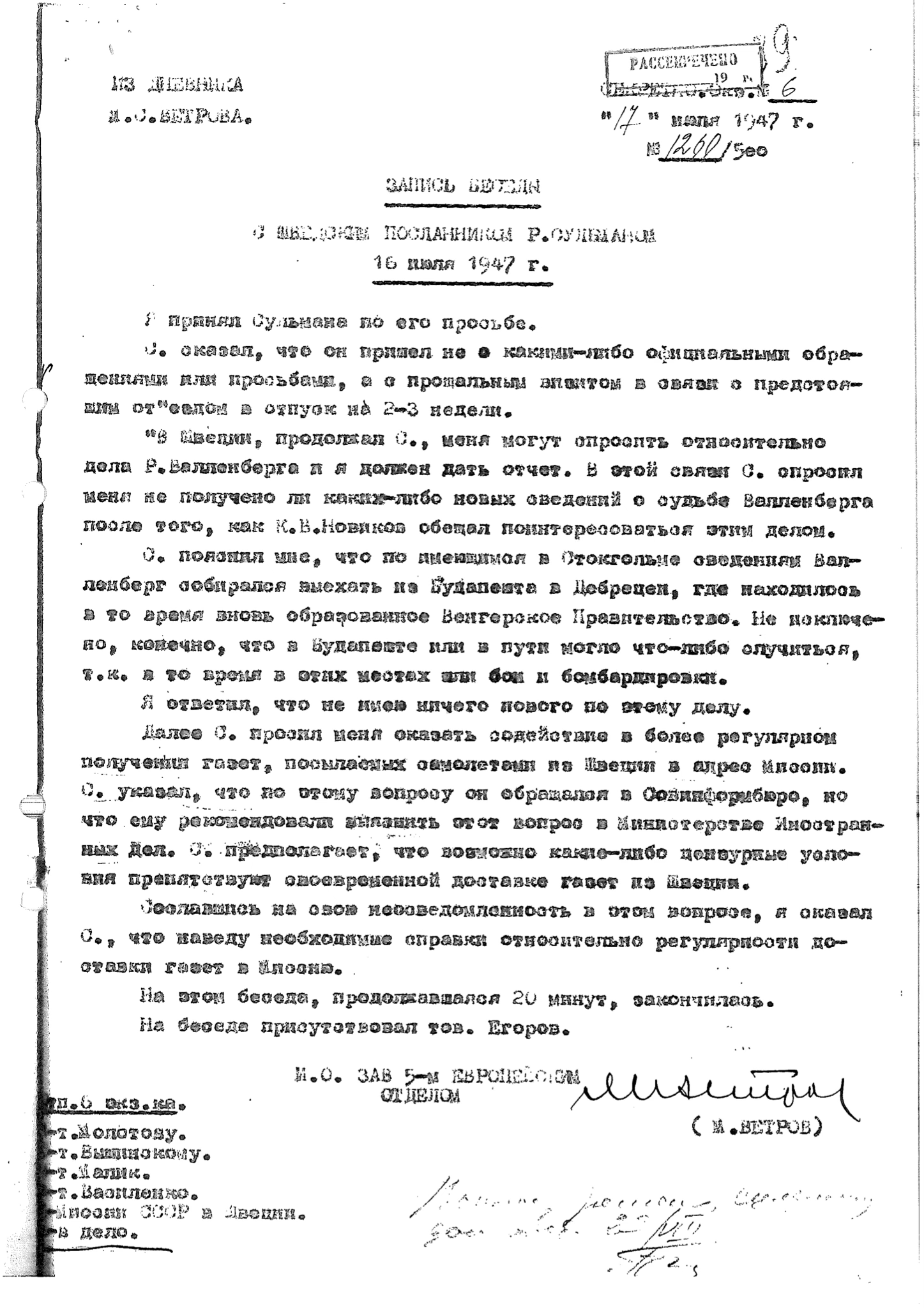
Fig. 1 Soviet diplomat Mikhail Vetrov’s report, dated July 16, 1947, of his meeting with Rolf Sohlman
Sohlman’s amplification of Staffan Söderblom’s 1946 message to Stalin
So far so good. Here comes the problem:
Sohlman’s own report of the July 1947 meeting differs considerably from Vetrov’s account. In fact, Sohlman suggested the exact opposite, namely that Vetrov had raised the scenario of Wallenberg’s death in Hungary back in January 1945 – a serious discrepancy that has gone largely unnoticed.
In his report to Swedish Foreign Minister Ősten Undén, Sohlman indicated that it was Vetrov who suggested that
“The fighting around Budapest had been especially intense and that much pointed towards the possibility that Wallenberg had died during the intensive bombings and firefights …”
According to Sohlman, it was the first time Vetrov had offered his personal commentary on the subject.
Why does all of this matter?
In Sohlman version, he was simply trying to inquire when the Soviet government would provide additional information about Wallenberg’s disappearance. Instead, Sohlman apparently did far more than that. Rather than pushing the Soviet authorities for a full accounting of Wallenberg’s fate, Sohlman was signaling what scenario the Swedish side was potentially willing to accept.
Sohlman’s wording as recounted by Vetrov is almost identical to the phrasing Staffan Söderblom used in a rare audience with Stalin the year before. Söderblom told Stalin that he was “personally convinced that Wallenberg had fallen victim to an accident or to bandits” while still in Hungary. Therefore, Sohlman’s alleged statement to Vetrov twelve months later did not constitute a noticeable departure from Söderblom’s position. More than that, it reinforced Söderblom’s message. As such, Sohlman’s remarks [and those made by Söderblom] reflected the official or rather the true position of the Swedish government – as it had been since Wallenberg’s disappearance in January 1945.
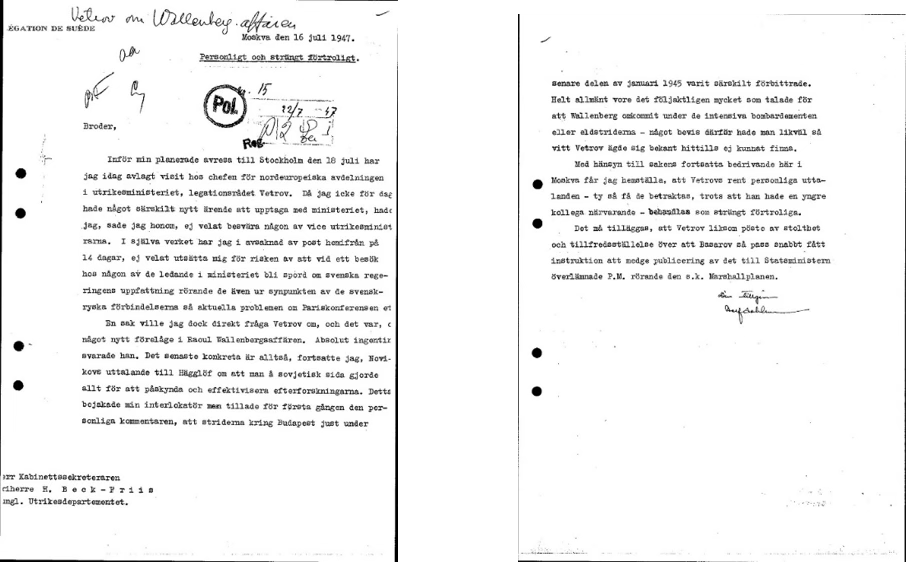
Fig. 2 Rolf Sohlman’s report about his meeting with Mikhail Vetrov, July 16, 1947
Without Vetrov’s report, it appears that it was the Soviet authorities (reiterating Staffan Söderblom’s message) who wished to reinforce the idea that Wallenberg was dead and not in the Soviet Union. Such a scenario – as claimed by Sohlman in his report – seemed entirely plausible, given the fact that other Soviet representatives had made similar statements a short time earlier; for example, the Soviet diplomat Kirill V. Novikov to the interim-Minister in Moscow, Gunnar Hägglöf, on January 30, 1947. Novikov indicated that Wallenberg could have become the victim of airstrikes, a scenario “that could not be excluded”, Hägglöf confirmed.
If correct, Vetrov’s account of his conversation with Sohlman a few months later indicates that Sohlman chose almost exactly the same approach as Staffan Söderblom had used the year before. If so, Sohlman’s actions cast additional doubt on the claim that Söderblom acted entirely on his own initiative, without prior consultation or at least tacit approval from his superiors (as the Eliasson Commission concluded in its report in 2003) when he conveyed the likelihood of Wallenberg’s death to Stalin.
Why would Sohlman misrepresent his remarks to Vetrov (presuming Vetrov’s report of Sohlman’s remarks is valid)? It is unclear what instructions Sohlman received before the meeting. Sohlman apparently considered the question of Wallenberg’s fate an unwanted irritant in Swedish Soviet relations. One possible explanation is that he did not want to appear to have followed Söderblom’s problematic lead, but the issue deserves closer examination. Just a month before his meeting with Vetrov, Sohlman and his daughter had been approached by an individual claiming to possess information that Wallenberg had died in a Soviet POW camp in Gödöllö, Hungary some time earlier. This information could have strengthened Sohlman’s conviction that Wallenberg was indeed no longer alive.
Sohlman’s alleged reinforcement of Söderblom’s message in July 1947 came at crucial moment. Just one month later, in August 1947, the Soviet government issued an official statement (the so-called Vyshinsky Note) that “[Raoul Wallenberg] is not in the Soviet Union, and he is not known to us. It remains only to assume that Wallenberg was killed or captured by Hungarian Nazis.”
In the various official reports published during the 1990s and early 2000s, Swedish officials cited Sohlman’s account as evidence that it was the Soviet side that repeatedly promoted the scenario that Wallenberg had died already in 1945 in Hungary. Vetrov’s report was available to the Swedish Russian Working Group (1991-2000) as well as the Eliasson Commission in (2003). Neither inquiry mentioned it in their final report. The omission of Vetrov’s account had consequences. It further cleared the way for a particular narrative – the singling out for blame of Ambassador Söderblom for essentially advancing the idea that Wallenberg had died in 1945 (which Soviet officials readily enhanced), thereby leaving Wallenberg to his fate.
A striking contrast between public rhetoric and behind-the-scenes signals
According to the diary of Swedish diplomat Lennart Petri who served with Ambassador Sohlman in Moscow for three years, from 1955 until 1958, neither the Swedish government nor its ambassador to the Soviet Union had any interest at all in pursuing the fate of Raoul Wallenberg. Rather than breaking with his colleagues’ passive approach, Sohlman’s main interest was simply to be rid of the matter. Sohlman’s desire to distance himself from the Wallenberg case was apparently so extreme that even Ősten Undén who did not pursue the issue with any vigor, did not trust him to make proper representations with the Soviet government.
By the early 1950s, the fiction that Wallenberg had never been taken to the Soviet Union was becoming more difficult to maintain. However, even after Stalin’s death in 1953, Sohlman did not include the question of Wallenberg’s fate on the list of open questions to be addressed with the new Soviet leadership.
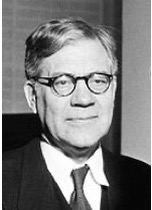
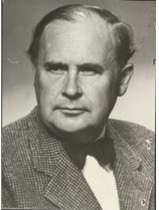
Fig. 3 Foreign Minister Ősten Undén. Source: Alchetron.com and Ambassador Rolf R. Sohlman in an undated photograph. Source: Sohlman’s personnel file, Swedish Ministry of Foreign Affairs, Swedish National Archive (Riksarkivet)
In November 1955 Sohlman once again signaled that the Swedish government was ready to let the Wallenberg case go. He told the Chairman of the Soviet Council of Ministers Nikolai Bulganin that the Swedish government would be satisfied with a statement that simply laid the blame for Wallenberg’s disappearance and possible death at the hands of the ruthless NKVD chief Lavrentiy Beria. Ősten Undén relayed virtually the same message a few months later (March 1956) to the Soviet Ambassador in Stockholm. Sohlman’s and Undén’s requests came precisely at a time when Swedish officials for the first time received first-hand confirmation that Raoul Wallenberg had been imprisoned in Moscow (through Wallenberg’s cellmate, the German SS officer Gustav Richter, released in October 1955).
Finally, on February 6,1957, Swedish officials received the answer they had been asking for: the Soviet government announced that Wallenberg had died suddenly a decade earlier, in July 1947, supposedly of a heart attack, in his prison cell in Moscow. The statement implicitly blamed the former Soviet Minister for State Security, Viktor Abakumov – Beria’s former deputy.
A mother’s unanswered question
The omission of Mikhail Vetrov’s 1947 report exemplifies the problem of limited source selection and restricted access to documentation in the construction of historical narratives. It is also symptomatic of the problems that have plagued the Wallenberg inquiry from its inception.
What seemed like a minor oversight helped further a portrait of Staffan Söderblom as a rogue actor who proceeded without prior authorization, and in doing so, almost singlehandedly sealed Raoul Wallenberg’s fate. Instead, Söderblom’s attitude and actions in the Wallenberg case represented the norm not the exception among his diplomatic colleagues. The Eliasson Commission acknowledged as much when it concluded that from the time of Wallenberg’s disappearance, the idea and even the expectation that he was dead “was not controversial” among those in charge of the investigation.
The fact that Swedish officials acted on this premise should not come as a revelation. What does remain unsolved is the question that Raoul Wallenberg’s mother posed almost eighty years ago: Why did Raoul Wallenberg’s disappearance elicit so little sympathy among Swedish officials and why did they so readily accept that he could not be saved? Or as Maj von Dardel framed the issue in early 1947, “Why do you assume my son to be dead?” Swedish diplomats – Lennart Petri, Rolf Sohlman, Gunnar Hägglöf and Staffan Söderblom among them – considered Wallenberg’s mother hysterical and a general nuisance, refusing to accept that her son might not return. Ultimately, a mother’s intuition proved correct. Raoul Wallenberg did not die in Hungary and during the years of 1945-47, he was imprisoned in the Soviet Union. Maj von Dardel could not save her son, but the question she posed continues to await an answer.